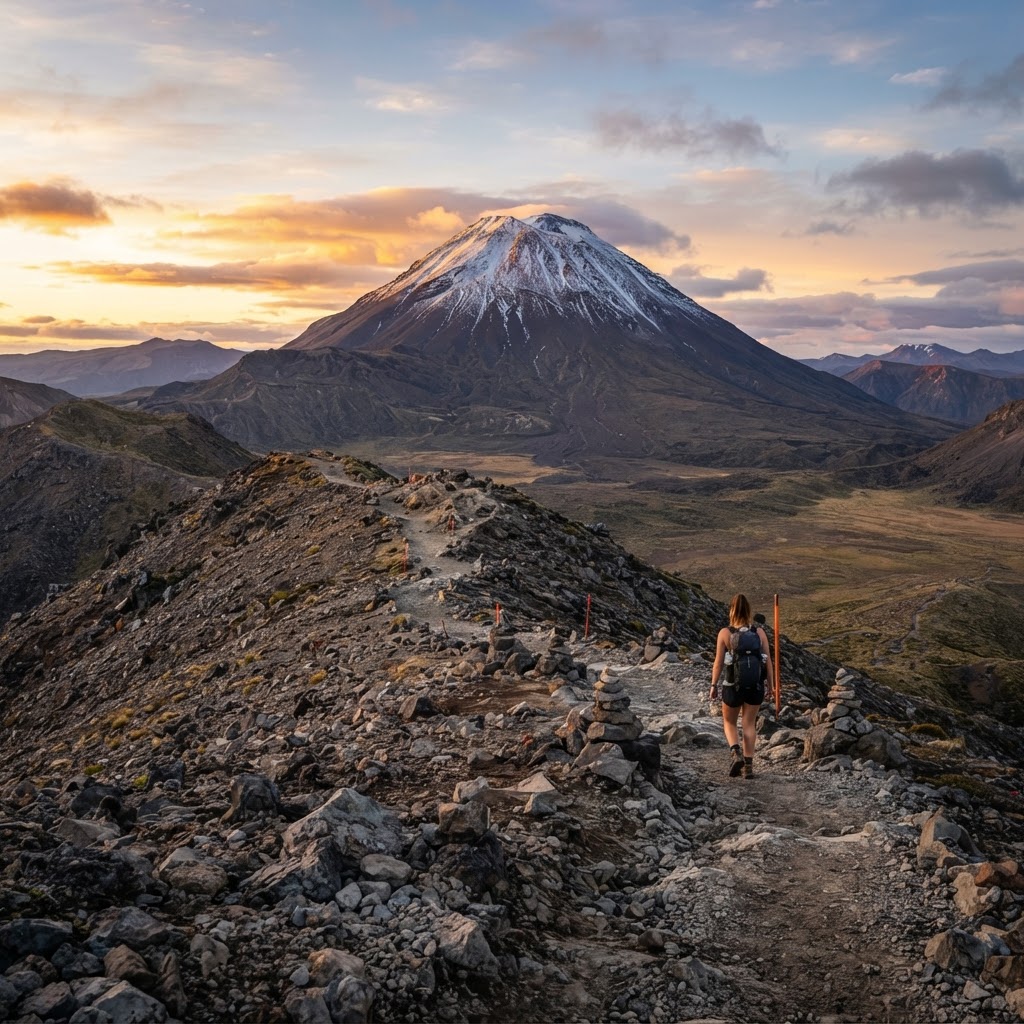
Tongariro Alpine Crossing Transport: How to Get Between Trailheads
Tongariro Alpine Crossing transport explained: trailhead locations, shuttle timing, parking, and why the walk is one-way. Complete logistics guide.
The Tongariro Alpine Crossing isn't a loop. That single fact determines everything about your transport logistics for New Zealand's most celebrated day walk, and it catches hundreds of trampers off guard each season.
You'll start at Mangatepopo Car Park on the western flank of Mount Tongariro and finish 19.4 kilometres later at Ketetahi Car Park on the mountain's northern slopes—two points separated by roughly 12 kilometres of winding rural road when you're not walking across volcanic terrain. Most visitors park at one end, walk to the other, then realise they're stranded without their vehicle. The transport question isn't optional—it's the mechanic that makes the crossing possible.
Why the Tongariro Crossing is One-Way
The track's design follows the mountain's natural contours. You climb 760 metres from Mangatepopo through ancient lava flows, cross the lunar expanse between Red Crater and Mount Ngauruhoe, then descend 780 metres through the Ketetahi thermal area toward native bush and the Ketetahi Road end. Turning this into a loop would require either backtracking the entire route (impractical and knee-destroying) or adding several additional hours through difficult terrain not served by formed track.
The Department of Conservation designed it as a point-to-point traverse specifically because that routing showcases the volcanic zone's most dramatic geology in a single day walk. You're not meant to return to your start point—the landscape wouldn't allow it elegantly. That's by design, but it creates the transport problem.
The Three Standard Transport Solutions
Shuttle services dominate the Tongariro transport market. At least six operators run scheduled services from Whakapapa Village, National Park Village, Turangi, and Taupo each morning during the walking season (roughly October through April, weather permitting). You book a pickup from your accommodation between 5:00 and 7:00 AM, they drop you at Mangatepopo around 7:30 AM, and you arrange collection from Ketetahi between 3:00 and 6:00 PM.
Most shuttles cost $45–$55 per person return. The system works efficiently for budget trampers and backpackers, but you're operating on their timetable—early starts regardless of your preference, and the pressure to finish the crossing by the last pickup window. Miss the final shuttle and you're arranging expensive taxi rescue from a car park with no mobile coverage.
Two-car solutions appeal to groups. You drive two vehicles to the Tongariro area, leave one at Ketetahi finish point, drive everyone in the second car to Mangatepopo start, complete the walk, collect the first car, then backtrack to retrieve the second vehicle. This introduces 40–50 minutes of extra driving, requires splitting your group, and means someone's navigating unfamiliar narrow roads twice. It works, but it's clumsy.
Private vehicle drop-off and collection is the third option, far less discussed but increasingly common among visitors who recognise their time as finite. You're collected from your accommodation—whether that's Taupo, Ohakune, or a property in the Whakapapa village area—driven to the Mangatepopo trailhead at a time that suits your walking pace, and collected from Ketetahi when you actually finish, not when a shuttle schedule dictates. Your driver handles the car logistics entirely.
Trailhead Locations and Road Access
Mangatepopo Car Park sits at the end of Mangatepopo Road, which branches south from State Highway 47 roughly 5 kilometres southwest of the SH47/SH46 intersection. The car park holds about 200 vehicles, fills completely most summer days by 7:30 AM, and has toilet facilities but nothing else. There's no mobile coverage. DoC rangers patrol during peak season but don't staff the site permanently.
The access road is sealed for most of its length but narrows in the final kilometre—safe for any vehicle but tight when shuttle buses pass rental cars. If you're driving yourself here, arrive before 6:45 AM in high season or accept you'll be parking on roadside grass.
Ketetahi Car Park marks the northern terminus at the end of Ketetahi Road, accessible from State Highway 46 between Turangi and Rangipo. This car park is smaller, holds perhaps 80 vehicles, and fills almost as quickly. The road is sealed but more winding than the Mangatepopo approach, and the car park itself sits in a bush-clad valley with limited sun—it feels more remote.
Critically, Ketetahi Road traverses land that holds significance for Ngāti Tūwharetoa, and the thermal features near the track's descent are tapu. DoC closed this section of track briefly following the 2012 Te Maari eruptions; it reopened in 2013 with restricted access through the thermal zone. Cultural sensitivity and volcanic risk both inform access decisions here.
Timing, Weather, and the Shuttle Trap
Most shuttle operators require you to estimate your finish time when booking. Fast trampers complete the crossing in six hours; average parties need seven to eight; slower or more photographically inclined groups take nine or more. Weather shifts dramatically on the mountain—what begins as clear dawn can become sleet-lashed exposure by Red Crater.
If you book a 4:00 PM collection and arrive at Ketetahi at 2:30 PM, you'll wait ninety minutes in a car park with no café, no shelter beyond the toilets, and patchy phone coverage at best. If you're delayed by weather or blisters and miss your shuttle window, you're problem-solving from a position of limited leverage.
The inflexibility isn't the shuttle operators' fault—they're running scheduled services with multiple pickup points. But it does create a mismatch between mountain time (governed by weather, fitness, and the mountain's majesty) and commercial transport time (governed by schedules, efficiency, and the next group waiting).
The Luxury Alternative Few Consider
Private point-to-point transfers eliminate the schedule pressure entirely. A professional driver collects you from your accommodation at a civilised hour, delivers you to Mangatepopo with your pack and weather layers organised, then returns to collect you from Ketetahi when you're actually finished—tracked by your estimated time and adjusted via mobile contact if you have reception or via DoC ranger updates if you don't.
This costs substantially more than a $50 shuttle—expect $800–$1,200 depending on your origin point and vehicle choice—but the value calculation changes when you're staying at premium properties in Taupo or Lake Tarawera and treating the crossing as one element of a curated itinerary, not a backpacker bucket-list sprint.
The driver handles the trailhead logistics entirely. You walk at your own pace, pause at Emerald Lakes for thirty minutes instead of five, and finish the crossing without the low-grade anxiety about making the last shuttle. On a trip where you're already investing in quality accommodation and guided experiences, the transport becomes consistent with the rest of your logistics rather than a jarring budget compromise.
Practical Details That Matter
Start early regardless of your transport method. The Mangatepopo valley funnels afternoon wind directly up the track, and Red Crater becomes genuinely unpleasant by 2:00 PM on blustery days. The cloud base typically lifts between 9:00 and 11:00 AM in summer—you want to be crossing the South Crater plateau during that window.
Carry cash for DoC donation. There's a intentions book and donation box at Mangatepopo; suggested contribution is $40 per person for international visitors, helping fund track maintenance on what's become New Zealand's busiest great walk by daily volume.
Don't assume mobile coverage. Neither car park has reliable signal, and most of the track offers none at all until you descend past the Ketetahi Shelter. If you're coordinating a flexible pickup, establish primary and fallback communication plans with your driver beforehand.
Weather closes the crossing frequently. DoC posts track status updates at both trailheads and online by 6:00 AM daily during the season. High wind, snow, or volcanic alert changes can shut the track with no notice. Your transport solution needs contingency flexibility—shuttle operators typically offer alternative dates or refunds, but you'll want clarity on that policy before booking.
After the Walk
Most trampers finish the Tongariro Crossing feeling the strange emotional cocktail of accomplishment, exhaustion, and slight disappointment that it's over. The volcanic plateau delivers an intensity that few New Zealand landscapes match—you're walking through geology so recent and raw it feels barely settled. That intensity doesn't suit a rushed transition back to ordinary logistics.
Whether you're heading onward to Rotorua, returning to Taupo accommodation, or continuing south, the hour after you leave Ketetahi should allow some decompression. The transport that makes that possible—patient, flexible, private—costs more than a shuttle seat, but it honors what you've just experienced rather than processing you as throughput.
If you're planning the Tongariro Crossing as part of a broader North Island itinerary and want transport that matches the quality of the walk itself, request a quote for point-to-point transfer from your accommodation. You'll finish the crossing properly, without the shuttle sprint.
Priya Sharma | Based in Auckland Priya writes about New Zealand's luxury travel landscape from Auckland, where she's spent a decade connecting international visitors with the country's premium experiences. Her background in hospitality strategy informs her practical approach to high-end logistics.
About the Author

Priya Sharma
Luxury Travel Writer & Transfer Consultant
Priya writes about New Zealand's luxury travel landscape from Auckland, where she's spent a decade connecting international visitors with the country's premium experiences. Her background in hospitality strategy informs her practical approach to high-end logistics.