The Tauranga to Rotorua Drive: What You Actually See Along the Way
The Tauranga to Rotorua drive via SH36 takes 55 minutes through farmland and forest. Here's what you'll actually see on this Bay of Plenty corridor.
The Tauranga to Rotorua drive doesn't make anyone's scenic highlight reel, and that's precisely why it's worth describing honestly. This is State Highway 36—a 55-kilometre corridor that connects the Bay of Plenty coast to the geothermal plateau—and if you're doing it, you're probably doing it with a purpose: a lodge booking in Rotorua, a flight to catch in Tauranga, or a rental car to return after a few days at the lakes.
It's not the Forgotten World Highway. It's not the Crown Range. But it is the most direct route between two places a lot of travellers need to connect, and knowing what you're actually in for makes the difference between a relaxed transfer and an anxious one.
The Route: SH36 From Coast to Plateau
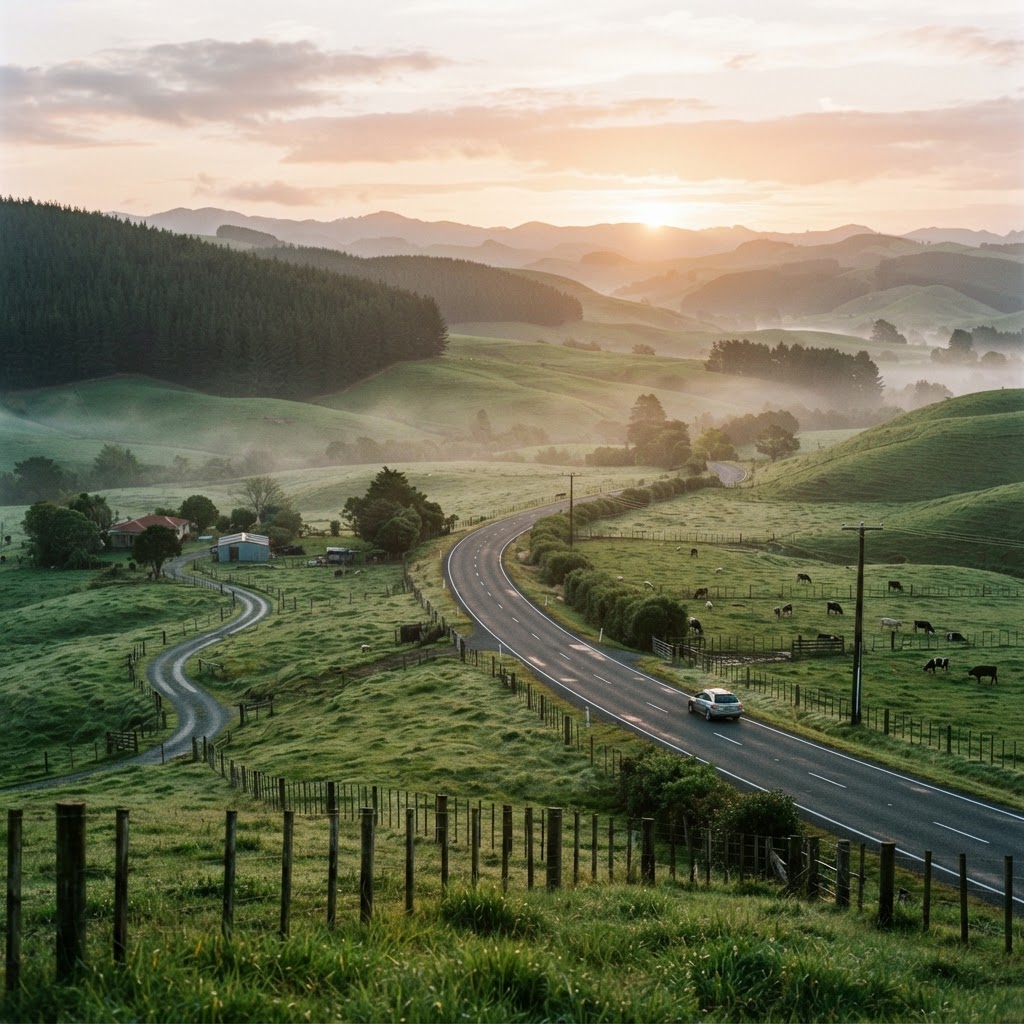
Leave Tauranga heading south on State Highway 36, and within three minutes you're out of suburbia. The road climbs gently away from the harbour through Pyes Pa and Oropi, where lifestyle blocks give way to larger pastoral holdings. The Bay of Plenty here is fundamentally agricultural—kiwifruit orchards in the flats closer to town, then dairy and drystock as you gain elevation.
The road is well-maintained, two lanes, with occasional passing zones. It handles holiday traffic without drama, though you'll notice campervans on weekends and school holidays. There are no significant stops between the two centres—no villages, no fuel stations after the Tauranga fringe—so this is a point-to-point corridor, not a browsing route.
Around the 20-kilometre mark, farmland starts breaking up into forestry blocks. Pinus radiata plantations dominate the middle section, and depending on the harvest cycle, you'll either be driving through dense green walls or clear-cut blocks regenerating under scrub. It's visually repetitive, but the road remains good and the corners are predictable.
What Changes As You Approach Rotorua
The shift happens about 15 kilometres out from Rotorua. The road descends slightly, the forestry breaks open, and you start to see steam rising from paddocks—geothermal vents that signal you've crossed into the Taupo Volcanic Zone. It's subtle at first, just wisps in the middle distance, then more obvious as you approach Ngongotaha and the outer Rotorua suburbs.
This is where the sulphur smell becomes noticeable if the wind is right. Not overwhelming, but present—a reminder that Rotorua sits on live geology. If you're arriving for the first time, it's a sensory marker that you've landed somewhere different from the coast you left an hour ago.
The highway transitions into Sala Street as you enter Rotorua proper, feeding you toward the lakefront and central accommodation. If you're heading to one of the lakeside lodges—Solitaire, Peppers on the Point, or properties further around Lake Rotorua—you'll peel off before the town centre, following the shoreline roads that access the quieter precincts.
The Return Direction: Rotorua to Tauranga
Heading back the other way, the dynamic changes slightly. You're climbing out of the geothermal basin through Ngongotaha, gaining altitude through the forestry zone, then descending gradually toward the coast. On a clear day, you'll get glimpses of Mount Maunganui and the harbour as you approach Tauranga—a visual signal that you're nearly back at sea level.
The Rotorua to Tauranga route is common for travellers returning rental cars to Tauranga Airport or connecting to cruise departures at the Port of Tauranga. It's also the corridor people use when flying out of Tauranga after a Rotorua stay, avoiding the longer backtrack to Auckland.
Timing matters here. If you're catching a flight, allow 75 minutes from central Rotorua to the Tauranga terminal—not because the drive takes that long, but because rental car returns, security, and domestic check-in consume time in ways that aren't always obvious when you're calculating backwards from a departure.
What This Route Isn't
This is not a sightseeing drive. There are no marked lookouts, no Department of Conservation walks signposted from the roadside, no cafés with cabinet food and lake views. SH36 is a functional corridor, and if you're expecting the Thermal Explorer Highway (SH5 from Taupo to Rotorua) or the coastal drama of SH2 south from Tauranga, you'll find this route underwhelming.
But functional doesn't mean unpleasant. The road is smooth, well-marked, and predictable—exactly what you want when you're navigating New Zealand roads for the first time or managing a tight connection. It's a drive where you can relax into the journey, set the cruise control, and not worry about surprise gravel sections or single-lane bridges.
The Logistics Most Visitors Underestimate
If you're picking up a rental car in Tauranga and driving to Rotorua, the mechanics are straightforward: collect the vehicle, load bags, follow SH36. But if you're doing this at the end of a trip—driving from Rotorua back to Tauranga Airport to return the car and fly out—the friction increases.
You'll need to refuel before the airport (the rental companies check). You'll need to locate the car return area, which at Tauranga Airport is separate from the terminal. You'll need to transfer bags, check in, clear security—all with a departure time that doesn't move. For an international traveller doing this sequence for the first time, in an unfamiliar vehicle, on the left side of the road, it's more cognitively demanding than it looks on paper.
The alternative is removing the vehicle entirely. A Tauranga to Rotorua transfer is door-to-door—waterfront hotel to lakeside lodge, no fuel stop, no return queue, no navigation. You're a passenger for 55 minutes, and someone else is managing the SH36 corridor while you're checking messages or watching the forestry blocks slide past.
When This Route Makes Sense
If you're based in Rotorua for several days and want to explore the wider region—Whakatāne, the lakes, Taupo—a rental car makes sense. You have the flexibility, the pricing works over multiple days, and the vehicle becomes a tool.
But if SH36 is a one-time connector between two fixed points—arriving in Tauranga, staying in Rotorua, then flying out of Auckland—the maths shifts. You're paying for a full day's rental to cover a 55-minute drive, managing an asset you'll use once, and absorbing the mental overhead of an unfamiliar road system.
The transfer model removes that friction. You're paying for the specific corridor you need, and the driver knows the SH36 rhythm—where the forestry trucks pull out, where the campervans slow down, how much time the Ngongotaha climb actually takes. It's the same road, same destination, different cognitive load.
What Happens in Practice
Most travellers default to the rental car because it's the obvious answer. They book it online, collect it at Tauranga Airport, drive to Rotorua, then either return it in Rotorua (which limits onward options) or keep it as expensive luggage until the next leg.
The question worth asking is whether the optionality of a rental car justifies the cost and complexity when the route is fixed and singular. If the answer is yes—if you're exploring, if you have time, if you enjoy driving—then SH36 is an easy, manageable corridor.
If the answer is no—if this is purely a transfer between a coastal arrival and a geothermal destination—then a private driver is the shape that fits the problem. Same road, same forest, same steam vents. Different side of the logistics.
If you're weighing the options, get a quote for the exact route you're planning. The numbers tend to clarify things quickly.
Sarah Tane
Based in Hamilton
Sarah has driven every major North Island corridor multiple times, usually with a lodge check-in time to meet. She writes about the routes most travellers navigate once—and the details that matter when you do.
About the Author

Sarah Tane
North Island Specialist & Lodge Liaison
Sarah has driven every major North Island corridor multiple times, usually with a lodge check-in time to meet. She writes about the routes most travellers navigate once—and the details that matter when you do.