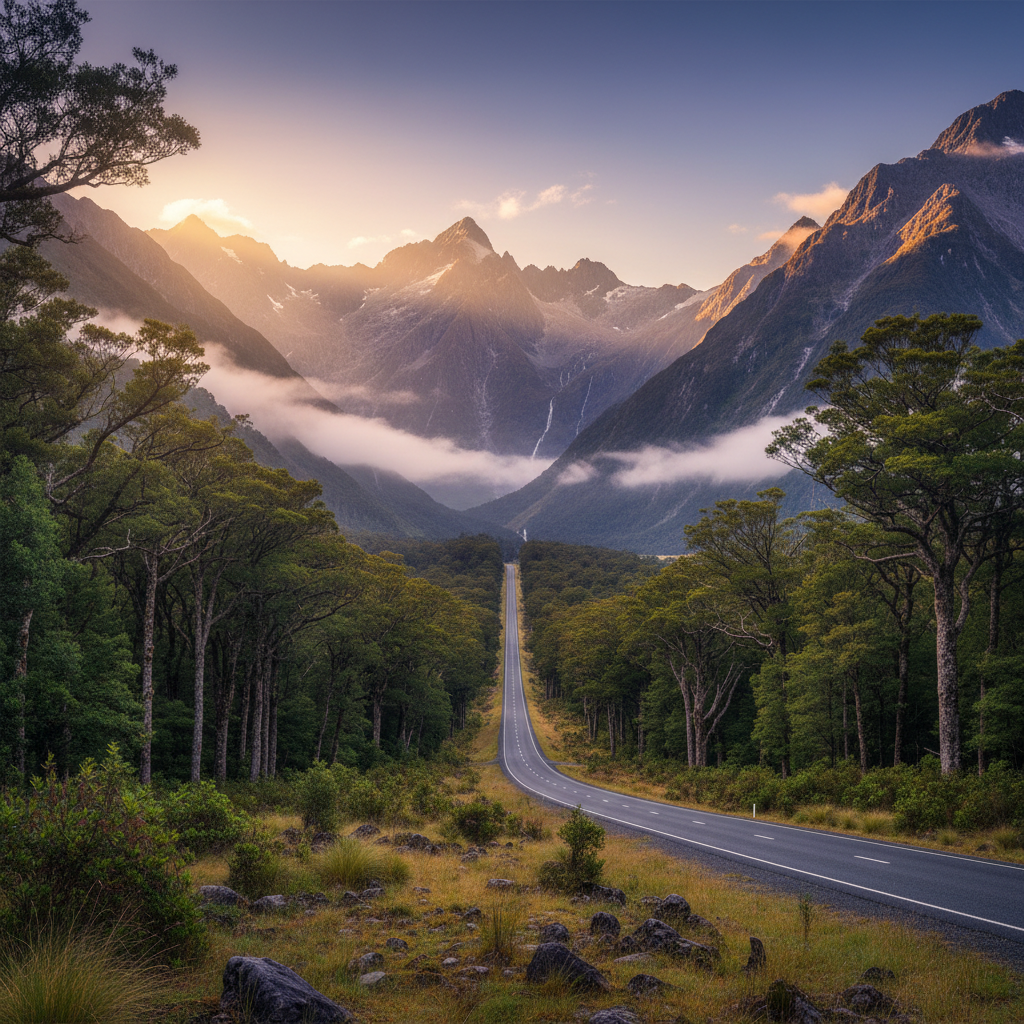
Queenstown to Milford Sound: Why the Road Beats the Flight
Queenstown to Milford Sound by road takes 4 hours via Te Anau. The drive through Fiordland delivers what the flight skips entirely.
The flight from Queenstown to Milford Sound takes forty minutes. The drive takes four hours minimum. Most visitors choose based on that arithmetic alone, which means most visitors see Fiordland from 3,000 feet and miss the reason they came to New Zealand.
This isn't romantic advocacy for the scenic route. It's a practical argument that the Milford Road (State Highway 94) is the attraction, and the fjord itself—spectacular as it is—makes sense only as the culmination of a journey through the landscapes that created it. The flight delivers you to a dock. The road delivers context, scale, and the incremental revelation that makes Milford Sound worth the pilgrimage.
The Route Architecture: Queenstown to Milford via Te Anau
There's only one road. Queenstown to Te Anau is 172 km via SH6 and SH95, taking roughly two hours through Frankton, past the Remarkables, skirting the eastern shore of Lake Wakatipu through Kingston, then cutting west through sheep country into Te Anau township. This section is handsome but unremarkable—you're not in Fiordland yet.
Te Anau is the gateway and the last fuel. From here, SH94 runs 118 km to Milford Sound. You enter Fiordland National Park almost immediately. The road follows the Eglinton River upstream through the Eglinton Valley, a glacial trough bounded by beech forest and the Livingstone and Eglinton Mountains. It's wide and golden in good light, tight and brooding under cloud.
The Homer Tunnel appears after the Mirror Lakes and Lake Gunn. Hand-hewn through solid rock between 1935 and 1954, it's 1.2 km long, unlined, one-way controlled by lights, and drops at a 1:10 grade. You emerge on the western side into a different climate zone. The Hollyford Valley drops 690 metres in 16 km through a series of switchbacks past the Chasm, where the Cleddau River has carved potholes into schist. Rain is near-constant here—Milford averages over 6,000 mm annually—and waterfalls multiply after any weather.
You arrive at the Milford Sound waterfront roughly four hours after leaving Queenstown, assuming no stops. With stops—and there should be stops—allow five.
What the Flight Skips
The scenic flight sees the results of glaciation. The road puts you inside the process. You watch the vegetation change as rainfall increases. You see the U-shaped valleys, the hanging tributaries, the lateral moraines. The Eglinton flats show you what a glacial outwash plain looks like when repopulated by beech and tussock. The descent from Homer shows you what happens when 6,000 mm of rain hits fractured rock at acute angles.
Air Milford and other operators charge around $449–$599 per person return for the flight, weather permitting. Cancellation rates are high—Milford's weather is famously uncooperative, and flights don't operate in cloud or high wind. When flights do run, you get spectacular ridge-line views and efficient transport. What you don't get is time to adjust, to let the scale accumulate, or to understand why this landscape looks the way it does.
The cruise operators assume you're coming by road. The commentary on board references the drive, the tunnel, the rainfall. If you've flown, you're receiving context in reverse.
The Return Leg Problem
Here's the detail most itineraries ignore: the return journey is not redundant. Light changes. Weather moves through. The Eglinton Valley in afternoon sun is unrecognizable from the morning version. If you've taken the dawn cruise to catch Mitre Peak in early light, you're driving back through Fiordland between 11 AM and 3 PM—the best window.
Many visitors solve Milford as a same-day return from Queenstown: leave at 6 AM, cruise at 11 AM, back by 6 PM. It works, but it's twelve hours of windscreen time if you're driving yourself. The alternative—overnighting in Milford—solves fatigue but creates a new problem, because accommodation at the sound is limited to Milford Sound Lodge and a small DOC campground. Most rooms are pre-booked by cruise-and-stay packages.
The sharper option: overnight in Te Anau. Drive to Milford in the morning, take an early afternoon cruise, return to Te Anau by evening. You've split the driving, kept the best light, and stayed somewhere with decent food and more than one building. Te Anau has twenty-odd lodges and motels; you'll find a room.
Private Transfer Economics
Rental car from Queenstown runs $80–$140 per day depending on vehicle and season. Fuel for the 580 km return is roughly $100. You're self-navigating, managing fatigue, and parking at Milford (free, but limited and often full by mid-morning).
A private transfer from Queenstown to Milford Sound for two passengers typically runs $1,400–$1,800 return, depending on operator and vehicle standard. For four passengers, closer to $1,800–$2,200. The per-person cost converges with flight pricing once you're past two people, but you've kept the road, added flexibility with stops, and eliminated driving after a full day.
For visitors connecting Milford into a broader South Island itinerary—say, arriving Queenstown and departing Christchurch—the transfer model allows a one-way Queenstown–Milford–Te Anau leg, overnight, then continuation north via Wanaka or Haast without backtracking. A private transfer from Queenstown to Wanaka could follow the next day, or a longer Queenstown to Christchurch routing via Mount Cook if timing allows.
Weather and Timing Considerations
Milford Sound receives rain two days out of three. The road closes several times each year for avalanche risk, usually in winter, sometimes after heavy rain. Real-time road status is available via NZTA's website and Journey Planner—check it the night before and again in the morning.
The best weather windows are early summer (November–December) and autumn (March–April), though "best" is relative in Fiordland. Rain isn't a reason to cancel. The waterfalls multiply, the sound becomes operatic, and the mood justifies the journey. Just bring layers and expect conditions to shift.
Cruise operators—Real Journeys, Mitre Peak Cruises, and Jucy—run multiple departures daily. The first departure (sometimes as early as 9 AM depending on season) sees the fewest people and the best light on Mitre Peak. Book ahead. Walk-ups are possible in shoulder season but risky in January.
The Case for the Road
If your Milford visit is a checkbox—fjord seen, photo taken—the flight is defensible. If you want to understand why New Zealand's landscapes carry the weight they do in global travel imagination, you drive. The road is the product. The sound is the punctuation.
For groups, families, or anyone stitching Milford into a South Island loop without the fatigue cost of self-driving, a private transfer holds the logic together. You're paying for the road to remain an experience rather than a chore, and you're keeping the return leg useful instead of merely necessary. If you're weighing options, request a quote with your travel dates and passenger count—routes like this price more sensibly than most visitors expect, especially when the alternative is a flight that skips the point entirely.
About the Author

Marcus Reid
Queenstown & Fiordland Route Driver
Marcus has driven every permutation of Central Otago's highway network over fifteen years guiding and logistics work. He writes about South Island routes with particular attention to return-leg economics and terrain.