The Hamilton to Rotorua Drive: What You Actually See Along the Way
The Hamilton to Rotorua drive via SH5 takes 90 minutes through pastoral Waikato and Mamaku Plateau pine forests. What to expect on this deceptive route.
The Hamilton to Rotorua drive is one of those New Zealand journeys that looks deceptively simple on a map—a clean diagonal line across the centre of the North Island, roughly 105 kilometres, nominally 90 minutes. But like many Kiwi routes, the reality is more textured than the tourism brochures suggest, and what you actually see from the driver's seat tells a different story than the destination photos.
I've done this drive enough times to know the petrol stations by their coffee quality and which corners tighten in wet weather. Here's what the route actually looks like, kilometre by kilometre, if you're planning to make the journey yourself or wondering whether there's a better way to get between these two cities.
The First Half: Pastoral Waikato and the Tirau Turn
Leaving Hamilton southbound on State Highway 1, you're in classic Waikato dairy country—flat to gently rolling pasture, shelter belts of macrocarpa and pine, the occasional weatherboard farmhouse set well back from the road. The landscape is productive rather than dramatic, the kind of countryside that made the Waikato New Zealand's agricultural heartland but doesn't inspire many Instagram stops.
At Tirau (about 35 minutes south of Hamilton), you leave SH1 and turn east onto State Highway 5. Tirau itself is famous for its corrugated iron sculptures—oversized sheep and dogs that function as shop facades—which are either charming or kitsch depending on your tolerance for roadside Kiwiana. There's a good bakery if you need caffeine, and clean public toilets, which matters more than it should on New Zealand drives.
This is where the route's character changes. SH5 begins its gradual climb toward the Mamaku Plateau, and the pastoral openness starts giving way to something darker and more enclosed.
The Mamaku Plateau: The Long Green Tunnel
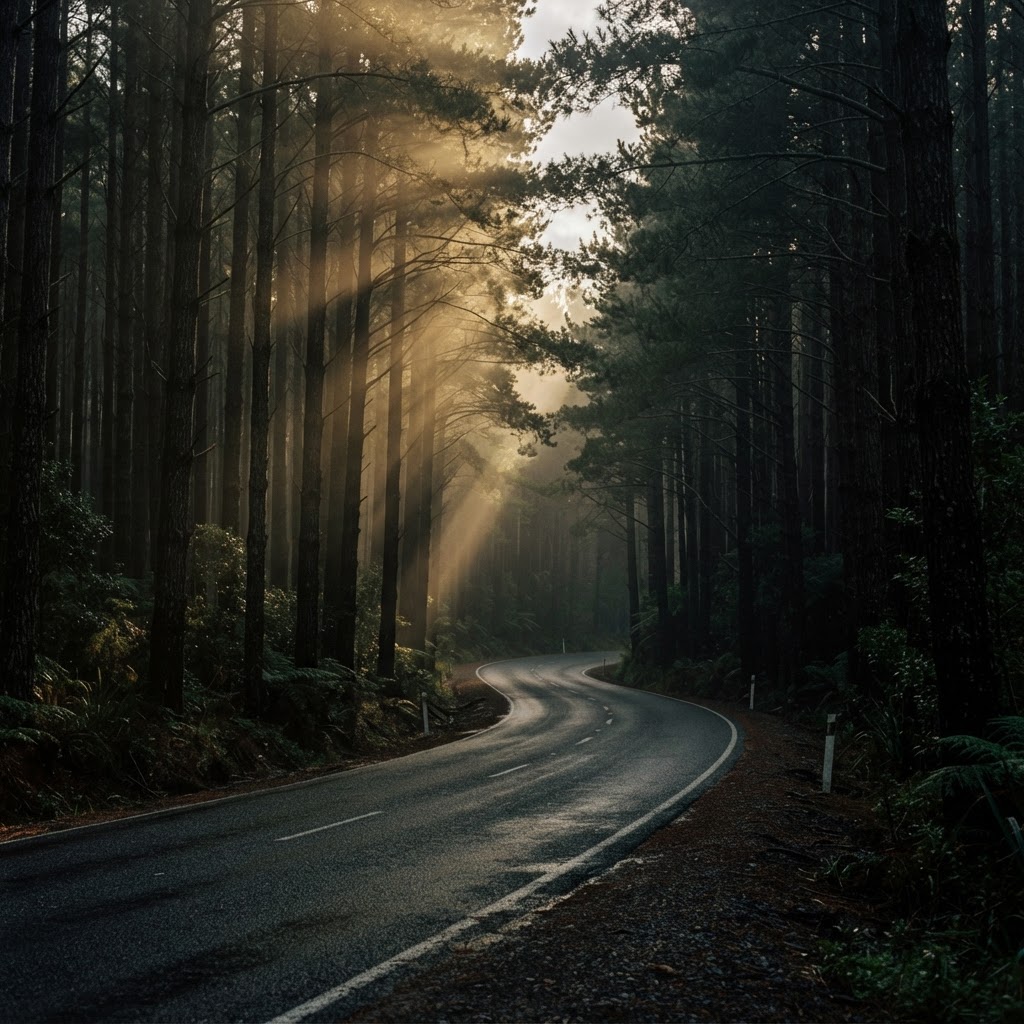
The middle section of the drive—roughly 40 kilometres through the Mamaku Ranges—is where most travellers realise this isn't the scenic cruise they imagined. You're climbing through dense plantation pine forest, the road winding upward in a series of moderate curves with limited visibility and virtually no views.
The Pinus radiata plantations here are working forest—commercial timber operations owned by various forestry companies—and they create a landscape that feels more Canadian than classically "New Zealand." The canopy closes overhead, light filters green through the branches, and for long stretches you see nothing but pine trunks marching away into shadow on both sides of the road.
It's not unpleasant, exactly, but it's not what most international visitors picture when they think of driving through New Zealand. There are no mountain vistas, no sheep on hillsides, no coast. Just forest, curves, and the occasional logging truck coming the other way, which requires your full attention.
The road surface on this section is generally good—Transit NZ maintains SH5 to a reasonable standard—but it's a route that demands concentration. The curves are tighter than they look on approach, the speed limit drops to 80 km/h in places, and in rain or low cloud the visibility can close right down. Passing opportunities are limited, which means if you end up behind a slow-moving vehicle or a campervan driver unfamiliar with the road, you may be there for a while.
The Rotorua Descent: Emerging Into Sulfur Country
Around the 60-kilometre mark from Tirau, the forest begins to open up and you start the descent toward Rotorua. The change is gradual at first—small clearings, glimpses of farmland—then suddenly you're out of the trees and dropping down toward the geothermal basin that defines Rotorua's landscape and economy.
On clear days, you can see steam rising from various points across the valley—geothermal activity from the Whakarewarewa Forest area and the city's various thermal reserves. The smell of sulfur dioxide becomes noticeable with the windows down, that distinctive rotten-egg scent that newcomers wrinkle their noses at and locals don't even register anymore.
The road straightens and widens as you approach Ngongotahā on Rotorua's western edge, transitioning from rural state highway to urban arterial. You pass the turn-off to Rainbow Springs and the Skyline Gondola, then descend into the city proper along Old Taupo Road or Fenton Street, depending on where you're headed.
Total journey time, assuming no stops and moderate traffic: 85 to 95 minutes. It's not a difficult drive, but nor is it a particularly rewarding one if you're doing it purely for the scenery.
What Most Travellers Don't Consider
Here's the practical reality: if you're travelling between Hamilton and Rotorua as part of a wider New Zealand itinerary—perhaps connecting between Auckland and Rotorua accommodation, or heading from Hamilton to one of the high-end lodges around Lake Rotorua—the drive itself is a means to an end rather than a highlight.
You're spending 90 minutes piloting an unfamiliar (and possibly right-hand-drive) rental car through forest with minimal scenery, arriving at your destination already a bit fatigued, then facing the question of what to do with the vehicle once you're there. If you're staying at somewhere like Solitaire Lodge or Treetops Lodge, the rental car often ends up sitting unused in their car park for days while you're out on guided activities.
The alternative—something many international travellers don't immediately think of—is to treat the journey as professional transfer rather than self-drive. The Hamilton to Rotorua route becomes a door-to-door connection rather than a navigational task: you're picked up from your Hamilton accommodation or arrival point, someone else handles the Mamaku curves and potential logging traffic, and you arrive at your Rotorua lodge without the rental counter paperwork or the km-limit calculations.
It's a different category of travel—not cheaper than rental necessarily, but optimised for a different set of priorities.
The Route in Different Conditions
Weather matters on this drive. The Mamaku Plateau sits at roughly 600 metres elevation, which means it can be wet and cold even when Hamilton and Rotorua are dry. Fog is common in winter mornings, reducing visibility to 50 metres in places. In heavy rain, surface water can accumulate in the forest sections where drainage is poor.
Seasonal light changes the experience more than you'd expect. Early morning drives in summer can be beautiful—low sun filtering through the pine canopy, mist still sitting in the valleys—but winter afternoon drives are often gloomy, with sunset coming early and the forest feeling particularly enclosed.
Traffic volume is moderate most days, heavier on Friday afternoons and Sunday evenings when Aucklanders are heading to or from Rotorua holiday homes. School holidays see a noticeable increase in campervans and rental vehicles, which can slow the Mamaku section considerably.
The Question of Stops
There aren't many compelling reasons to stop between Tirau and Rotorua unless you need facilities. Fitzgerald Glade, about halfway through the plateau section, has a small picnic area and toilets—useful for families with children, but not a destination in itself.
Some travellers detour slightly to Okere Falls on the northeastern approach to Rotorua, where the Kaituna River drops through a series of rapids. It's worth 20 minutes if you're interested in the geography, but it adds time to the journey and requires backtracking if you're headed into central Rotorua.
Most people, honestly, just want to complete the drive and get on with whatever brought them to Rotorua in the first place—the geothermal attractions, the mountain biking, the lodge experience, the Māori cultural offerings.
If you're weighing up whether to drive this route yourself or arrange a private transfer, the honest answer depends on what you're optimising for. The drive is straightforward enough for confident drivers familiar with New Zealand roads, but it's not a scenic highlight, and the practical logistics of rental pickup, dropoff, and parking can consume more time than the drive itself. You can request a quote for Hamilton to Rotorua and compare the numbers against rental—sometimes the math is closer than you'd expect, particularly once you factor in your own time and attention.
Sarah Tane — Based in Hamilton Sarah has driven every significant route in the North Island's central corridor, often multiple times per week. She writes about the practical realities of New Zealand road travel with an eye for detail most travellers miss until they're already committed.
About the Author

Sarah Tane
North Island Specialist & Lodge Liaison
Sarah has driven every major North Island corridor multiple times, usually with a lodge check-in time to meet. She writes about the routes most travellers navigate once—and the details that matter when you do.