Getting to Eagles Nest Bay of Islands: Your Access Options Decoded
Eagles Nest Bay of Islands access: drive times from Auckland (3h45), Kerikeri (25min), ferry logistics, and why the road journey beats flying north.
Eagles Nest sits on 75 acres of private peninsula between Russell and Rawhiti, overlooking the Bay of Islands Marine Park. It's one of New Zealand's most awarded luxury retreats, and getting there requires more thought than your average hotel transfer. The property doesn't have a street address you can punch into Google Maps. There's no shuttle service from town. The final approach involves a private driveway that climbs through regenerating native bush to five clifftop villas that guests pay $3,500–$8,500 per night to occupy.
Most international guests booking Eagles Nest face the same question: how do I actually get there? The property is remote by design, which is precisely the point, but that remoteness creates a logistics puzzle between your international arrival point and your villa check-in at 3pm.
Let's decode the access options with the kind of detail the Eagles Nest booking team usually has to explain over email.
The Geography: Where Eagles Nest Actually Sits
Eagles Nest is 6.4km northeast of Russell by water, but 18km by road. Russell itself is accessible only by vehicular ferry from Opua (10 minutes, $45 return) or passenger ferry from Paihia (12 minutes, frequent departures). The property's land access is via Rawhiti Road, which branches off Purerua Road, which connects to State Highway 11 north of Opua.
If you're coming from Auckland, you're looking at 230km and 3 hours 45 minutes via SH1 to Kawakawa, then SH11 through Opua and around the eastern Bay of Islands coastline. From Kerikeri Airport, it's 35km and roughly 25 minutes of driving. From Paihia township—where most Bay of Islands hotels cluster—it's 22km via the Opua car ferry route, call it 40 minutes dock to villa assuming no ferry queue.
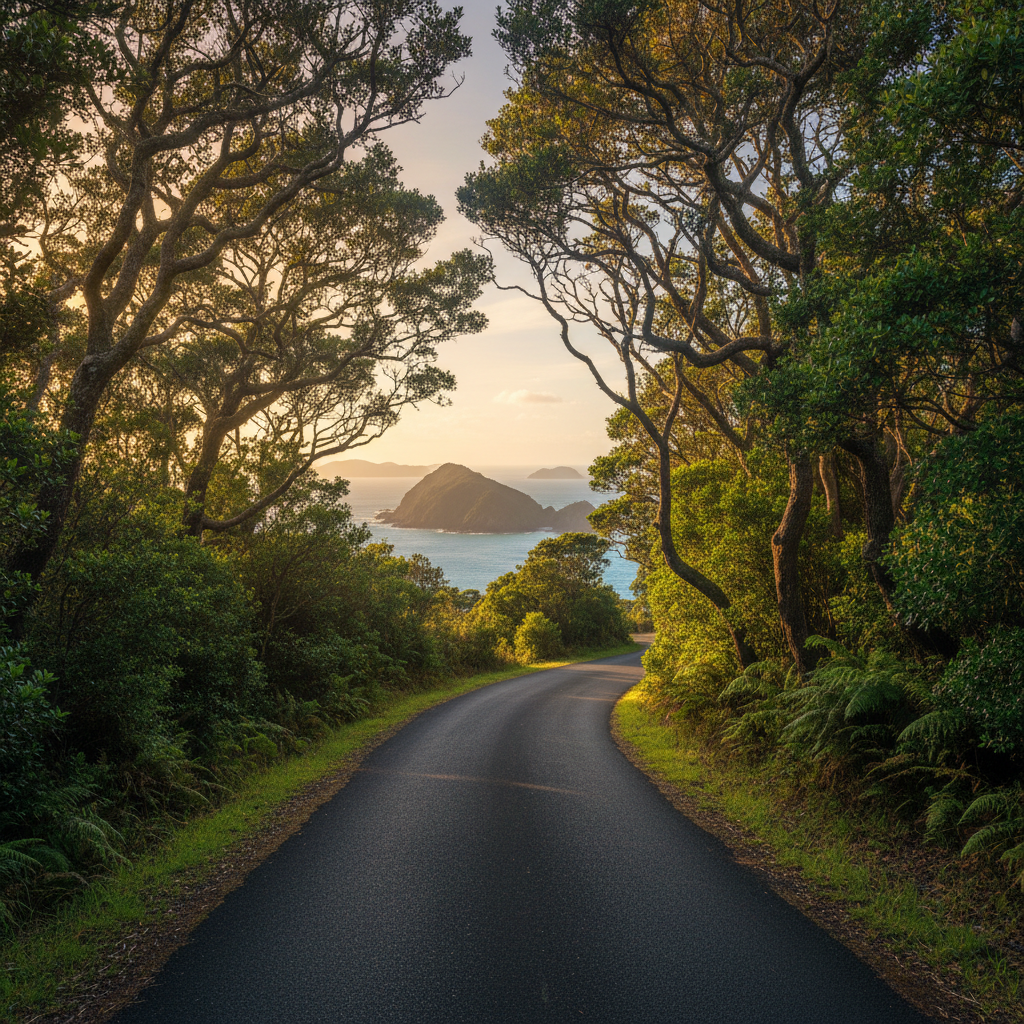
The final 8km along Rawhiti Road is sealed but narrow, winding through farmland and coastal bush with limited shoulders and occasional livestock. It's perfectly navigable in a standard vehicle, but it's not a road you want to drive tired, in the dark, or while trying to follow GPS instructions that lose signal in the valleys.
Option One: Fly to Kerikeri, Rent a Car
Air New Zealand runs three to four daily flights from Auckland to Kerikeri (Bay of Islands Airport), flight time 50 minutes, typically $160–$280 one-way depending on booking lead time. The airport is small, well-run, and has Avis, Hertz, and Budget desks. You can be in a rental car within 15 minutes of landing.
The drive from Kerikeri to Eagles Nest is straightforward: south on SH10 to the Purerua Peninsula turnoff, then coastal roads to Rawhiti. The route is scenic—rolling farmland, glimpses of inner harbour—and takes about 25 minutes in good conditions.
The friction points: You're paying for three to four days of car rental (minimum booking policies often apply) to make a single 25-minute drive. The car then sits unused at the property while you're in residence—Eagles Nest is a destination unto itself, most guests never leave the peninsula during their stay. On departure, you're retracing the route to return the vehicle, adding 50 minutes to your onward travel. If you're connecting south to Auckland for an international departure, you're either driving 3h45 back down SH1 or returning the Kerikeri rental and booking a second flight.
Total cost for the Kerikeri fly/drive option: $320–$560 in airfares (return), $280–$400 in rental and fuel, plus the cognitive load of driving unfamiliar roads after a long-haul international arrival. Budget $600–$960 per couple, and you're still doing the driving.
Option Two: Drive from Auckland
Many guests, especially Australians accustomed to long drives, collect a rental car at Auckland Airport and drive north on SH1. It's a legitimate option if you're building in stops—Matakana for the weekend market, Mangawhai Heads for lunch, Whangarei Falls for a leg-stretch.
The drive itself is easy: SH1 is New Zealand's main arterial, mostly two-lane but well-maintained, with passing lanes on the major climbs. Auckland to Warkworth is 50 minutes, then another hour to Whangarei, then 75 minutes to Kawakawa where you turn east toward the coast. The final 45km via SH11 and Rawhiti Road shifts from highway to country road—tighter corners, more scenery, slower speeds.
The calculation: Four days of rental at $85–$130/day plus fuel costs around $420–$590 total. You're saving the airfare, but you're adding 7h30 of driving (return) to your itinerary. If you've just flown 16 hours from Los Angeles or 12 hours from Singapore, that's a big ask on arrival day. The drive is beautiful—Mangawhai clifftops, the Brynderwyn Hills, Northland's rolling green—but it's not a casual afternoon jaunt.
Most guests doing the self-drive route end up breaking it with an overnight, which adds accommodation cost and turns a long day into two days of logistics.
Option Three: Private Transfer Direct
The access option that Eagles Nest doesn't advertise but many returning guests quietly arrange: a private driver in a premium vehicle, door to door. You land at Auckland Airport, meet your driver at arrivals, settle into a leather seat, and arrive at your villa 3h45 later without touching a steering wheel or fuel pump.
No rental counter. No navigation. No decision fatigue about whether to stop in Warkworth or push through to Kawakawa. Your driver knows the route, knows where SH1 slows for roadworks north of Wellsford, knows the Opua ferry schedule if an eastern route makes sense, and knows that the left-hand Rawhiti Road turnoff comes up suddenly after the Purerua Peninsula sign.
For the return leg, the same logic applies: your driver collects you from Eagles Nest at whatever time works for your onward international flight from Auckland, and you're back at the terminal with zero navigation stress.
The maths on this usually surprises people. A return private transfer Auckland Airport to Eagles Nest runs approximately $2,400–$2,800 for the vehicle (one to four passengers). That's comparable to—or less than—two people flying to Kerikeri and renting a car, once you account for the return flight, rental days you don't use, and fuel. For three or four passengers, the per-person cost drops significantly.
But the real value isn't financial—it's temporal and cognitive. You're buying back seven hours of driving, the mental energy of navigating unfamiliar roads, and the risk of arriving at a $6,000/night villa frazzled from three hours behind the wheel.
What Eagles Nest Guests Actually Do
In fifteen years of working with Northland lodge transfers, I've noticed a pattern: first-time guests fly and drive; returning guests arrange private transfers. Once you've done the Auckland-to-Bay-of-Islands drive once, you understand why the second time, you'd rather pay someone else to do it.
The guests who get it right from the start are usually those connecting from another New Zealand leg—Queenstown to Auckland, then north to Eagles Nest—who've already internalized that New Zealand's luxury is in the landscapes between the destinations, and that the transfer itself can be part of the experience rather than a logistics problem to solve cheaply.
The Practical Recommendation
If you're stopping elsewhere in Northland—Kauri Coast, Hokianga, Cape Reinga—the rental car makes sense. If Eagles Nest is your sole North Island destination before flying home, it doesn't. The drive north is too long to enjoy after international travel, and the drive south on departure day eats half your final day.
A private transfer lets you arrive rested, lets you work or sleep or watch the Northland landscape unreel outside the window, and eliminates the return-leg logistics entirely. You can request a quote with your specific arrival and departure times—most operators can accommodate early morning or late evening pickups to match international flight schedules—and you'll have a single fixed cost and zero decision points between touchdown and check-in.
Eagles Nest is extraordinary because it's remote. Getting there shouldn't be the hard part.
About the Author

Sarah Tane
North Island Specialist & Lodge Liaison
Sarah has driven every major North Island corridor multiple times, usually with a lodge check-in time to meet. She writes about the routes most travellers navigate once—and the details that matter when you do.