What the Christchurch to Twizel Journey Is Really Like
The Christchurch to Twizel drive crosses 330km of Canterbury plains and Mackenzie Country. Here's what actually happens on this route.
The Christchurch to Twizel run doesn't look like much on a map—330 kilometres of state highway threading through the interior. But this is one of those South Island journeys where the roadbook tells you nothing and the windscreen tells you everything.
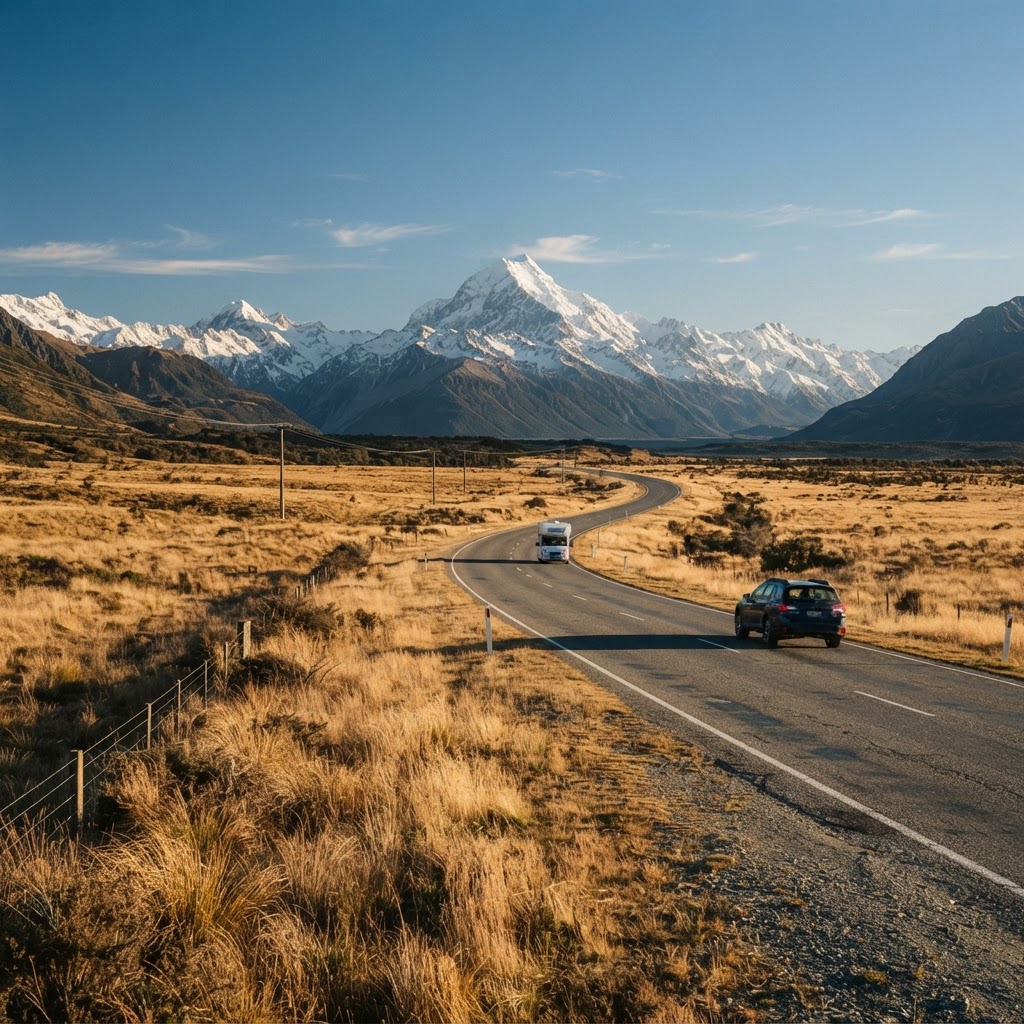
You're crossing from coast to alpine basin, sea-level to 500 metres, green Canterbury to bleached Mackenzie tussock. The light changes. The air thins. The mountains stop being a postcard and become geometry you navigate by.
Most visitors rent a car at Christchurch Airport and point it southwest. That works fine if you know the rhythm of SH1, SH72, and SH79—and if you're prepared for what happens when the terrain starts dictating your schedule instead of Google Maps.
The Route Mechanics: Two Ways, One Reality
There are two legitimate options out of Christchurch. Both take around four hours in good conditions, which tells you immediately that conditions matter.
Option One: SH1 to SH79 via Geraldine
This is the faster route on paper. South on SH1 through Rakaia and Ashburton, then inland at the Orari turn-off onto SH79. You're crossing the Canterbury Plains for 90 minutes—dead flat, ruler-straight, monotonous in that particular way that makes you question your caffeine intake. Past Geraldine the road lifts into rolling hill country, then drops you into Fairlie at the threshold of the Mackenzie Basin.
From Fairlie it's SH8 all the way—past Lake Tekapo's improbable blue, through the empty stretch to Twizel where the braided Ohau River appears like scar tissue across the valley floor.
Option Two: SH1 to SH72 (Inland Scenic Route)
Longer by 20 minutes, considerably more interesting. This peels off SH1 earlier and runs closer to the foothills—you're trading speed for texture. The road passes through Methven, skirting the base of the Two Thumb Range, before rejoining the main route near Fairlie.
In summer this is the thinking driver's choice. In winter it's the road that closes first when weather moves through.
What Actually Slows You Down
Time-of-departure planning matters here more than most routes. Leave Christchurch at 10am and you're golden. Leave at 1pm in January and you're hitting Tekapo at peak tour-bus gridlock, which turns a 15-minute fuel-and-toilet stop into 40 minutes of car park Tetris.
Fairlie is your last proper services before Twizel. Miss it and you're running the final 100 kilometres on whatever you've got in the tank—literally and metabolically.
The Burkes Pass section between Fairlie and Tekapo is where rental drivers reliably misjudge corners. It's not technically difficult, but the gradient tightens and the sight-lines shorten just as the landscape opens up and becomes distracting. You're no longer looking at the road; you're looking at Aoraki/Mt Cook filling the windscreen 80 kilometres away.
Winter adds the usual coefficient—black ice on shaded corners, snow on the high points of SH8, and the psychological load of checking road-snowfall warnings every two hours. Chains aren't commonly required on this route, but the conversation about whether you might need them occupies more mental real estate than it should.
The Twizel Arrival: Why You're Actually Here
Twizel doesn't announce itself. You crest a low rise on SH8 and it's just there—a grid of streets laid out with the geometric honesty of a 1960s hydro-town, which is exactly what it is.
Most people aren't staying in Twizel itself. They're heading to Pukaki Lodge, Mackenzie Country Hotel, Omahau Downs, or one of the high-country stations converted into luxury rural accommodation. These properties sit outside town, accessed via unsealed roads that branch off SH8 like capillaries.
If you've driven yourself, you're now dealing with the handbrake-turn reality of gravel driveways, unsigned turnoffs, and property gates that may or may not require a code texted to you three days earlier.
If your lodge is on the western side of Lake Pukaki—toward Aoraki/Mt Cook Village—you're adding another 40 minutes of driving into alpine terrain where cellular coverage becomes polite fiction and your vehicle's turning circle matters more than its Bluetooth connectivity.
The Calculus Nobody Mentions
Here's the part the rental-car math doesn't include: you've just driven for four hours. You're now at a lodge built around stillness, space, and the kind of silence that only happens at 500 metres above sea level with no city lights within 100 kilometres.
The expectation is that you'll spend the next two days hiking the Mount Cook Hooker Valley Track, cycling the Alps 2 Ocean Trail, or photographing Lake Pukaki at dawn when the water turns that silicon-enhanced blue that looks fake but isn't.
None of that pairs well with the cognitive overhead of a rental car sitting in the lodge car park, burning $140 a day, requiring you to drive yourself back to Christchurch—or onward to Queenstown—when your legs are still remembering what 17 kilometres of alpine trail feel like.
The alternative model—someone else handling the Christchurch-Twizel leg, dropping you at the lodge door, and either returning for you or continuing you onward—removes the asymmetry. You're not managing a vehicle. You're managing an itinerary.
The Return Leg (Or Lack Thereof)
Most Twizel itineraries don't loop back to Christchurch. They continue southwest to Queenstown via Cromwell (two hours), or southeast to Dunedin via Omarama (three hours).
If you do need to return to Christchurch, the drive reverses but the experience doesn't. Heading northeast, the mountains recede behind you and the plains open up like a slow exhalation. It's easier psychologically but no shorter in duration.
This is where the Christchurch to Twizel transfer model shows its geometry: a dedicated driver handles the outbound leg, you do what you came to do, and the return is either a separate pickup or part of a multi-segment itinerary that connects Twizel to your next destination without backtracking.
What the Route Actually Delivers
The Christchurch-Twizel drive is not scenic in the Milford Sound sense. It's not white-knuckle. It won't generate Instagram content every 15 minutes.
What it does is transition. You're crossing from the ordered, coastal, populated Canterbury into the Mackenzie—a landscape that operates on geological time and doesn't particularly care whether you're comfortable.
The sky gets bigger. The light gets harder. The mountains stop being scenery and become infrastructure—they create the weather, they shape the water, they explain why Twizel exists where it does.
If you're driving yourself, you'll experience all of this while also managing fuel stops, navigation, and the slow-burn fatigue of four hours at the wheel. If someone else is driving, you'll experience it from the passenger seat with a clear windscreen, no deadline pressure, and the option to actually look at what you're passing through.
That's the difference between completing the journey and experiencing it. Both get you to Twizel. Only one gets you there ready for what comes next.
If you're planning this route and prefer to arrive without the wheel-fatigue, request a quote and talk through timing, pickup points, and whether your itinerary continues south or loops back. The road doesn't change, but how you cover it does.
James Whitfield
Based in Christchurch
James has driven every major South Island route for the past twelve years, specialising in alpine access and terrain logistics. He advises on winter transfers and lodge positioning across Canterbury and Otago.
About the Author

James Whitfield
Senior Driver & South Island Route Specialist
James has driven every major South Island route for the past twelve years, specialising in alpine access and terrain logistics. He advises on winter transfers and lodge positioning across Canterbury and Otago.