Christchurch to Kaikōura: The Coastal Route That Changed Everything
Christchurch to Kaikōura drive via SH1: 180km of post-earthquake engineering, seal colonies, and why the coastal route beats flying every time.
The Christchurch to Kaikōura drive is 180 kilometres of the most rebuilt highway in New Zealand. When the 7.8-magnitude earthquake hit just after midnight on 14 November 2016, it lifted the seabed by two metres in places, dropped massive slips across State Highway 1, and severed the coastal route completely. For thirteen months, Kaikōura was accessible only by air or a long inland detour via Waiau.
Since SH1 reopened in December 2017, the route has become something else entirely: $1.1 billion worth of precision engineering, seventeen major construction projects, and a road that in many sections now runs on entirely new alignment. What was a scenic coastal drive is now a masterclass in resilience infrastructure—and still one of the most visually arresting transfers in the country.
If you're heading to Kaikōura for whale watching, crayfish, or a night at one of the coastal lodges, the question isn't whether to drive—it's who does the driving, and whether you're prepared to actually see what's alongside the road.
The Route: Christchurch to Kaikōura via SH1
The drive is straightforward in theory. You leave Christchurch heading north on SH1, pass through the Waimakariri floodplains, skirt the coast at Amberley, and then commit to two hours of uninterrupted coastal road from the Haumuri Bluffs all the way to Kaikōura township.
Total distance: 182 kilometres.
Drive time: 2 hours 20 minutes minimum, which no one ever does because there are seven places you'll want to stop.
The route breaks into three distinct sections:
Christchurch Airport to Cheviot (first 100km): Flat Canterbury Plains. Pastoral country, pivot irrigators, the occasional nor'wester blasting across open paddocks. Unremarkable until you cross the Waiau River and the Hundalee Hills rise on your left. This is where the coast commits.
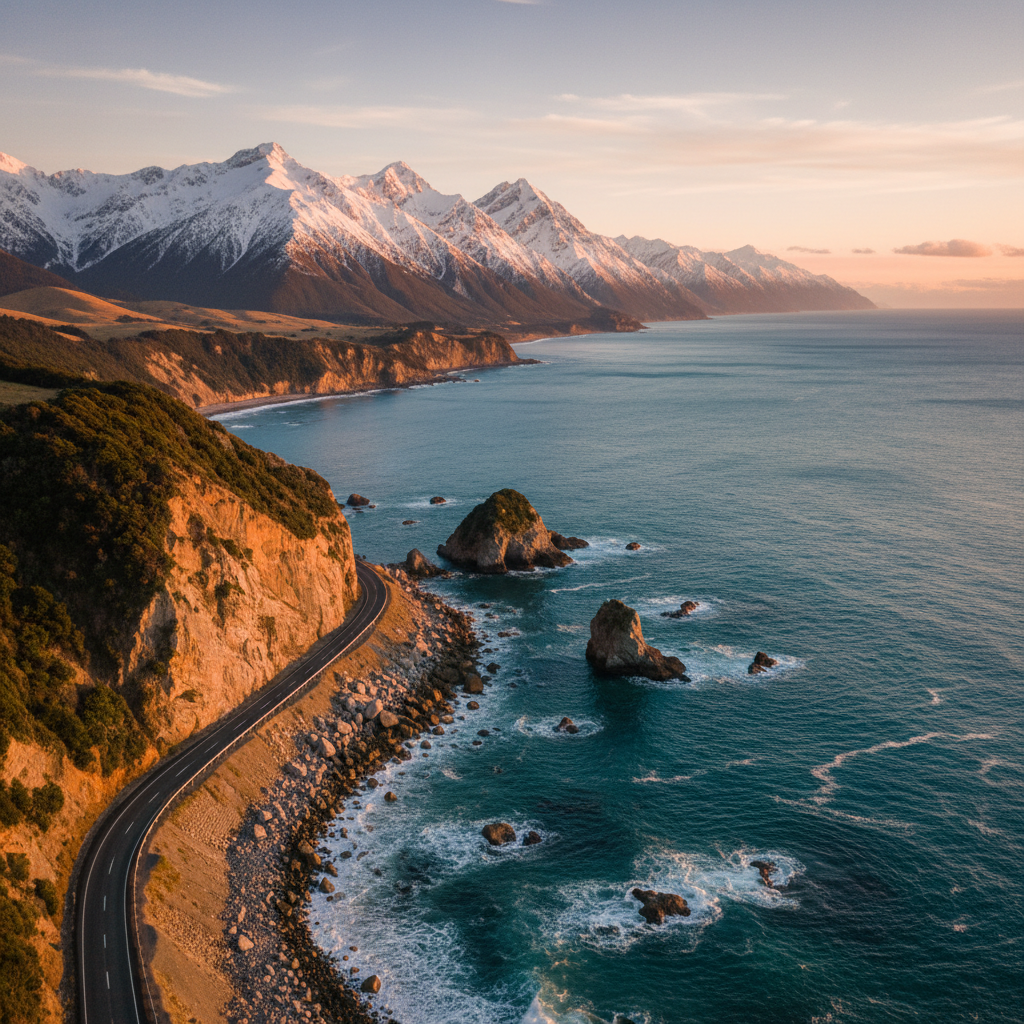
Cheviot to Oaro (50km): The road climbs into the hills and you start seeing the ocean properly. Goose Bay, the Haumuri Bluffs, and then the transition onto the rebuilt coastal sections where concrete retaining walls hold the hillside back and the highway runs on reclaimed benches cut into the cliff face. This is where geology becomes visible.
Oaro to Kaikōura (final 32km): The showpiece. The road runs right beside the Pacific, with the Seaward Kaikōura Range rising 2,600 metres directly behind the township. On clear days the peaks hold snow into November. You'll see seal colonies at Ohau Point, limestone outcrops, and if you're on the road at the right tide, you can watch waves break over platforms that didn't exist before the earthquake.
What the Rebuild Actually Means
Every driver on this route is travelling on $1.1 billion of earthquake recovery work. That's not hyperbole—it's the NZTA project budget. The rebuild involved:
- Realigning 10 kilometres of highway onto new routes where the old road was unsalvageable
- Stabilising 80,000 tonnes of rock above the road corridor
- Building new bridges over slip zones at Ohau, Half Moon Bay, and Rakautara
- Installing 20 kilometres of catch fences and rock mesh to manage ongoing rockfall risk
- Raising sections of road by up to 1.5 metres to accommodate future seismic events
What this means for drivers: the road surface is immaculate on the rebuilt sections. Wider shoulders, improved sightlines, and none of the patched-over repairs you see on older highways. But it also means permanent 80–90 km/h speed limits through several sections, and electronic warning signs that activate when geotechnical sensors detect instability.
You don't drive this route on autopilot. It demands attention—not because it's dangerous, but because the engineering and the landscape are both working at scale.
The Ohau Point Seal Colony
At 151 kilometres north of Christchurch, just before the road drops toward Ohau Stream, there's a Department of Conservation car park on the inland side of the highway. This is the access point for the Ohau Point seal colony—New Zealand fur seals that haul out on the rocks year-round, with pups born from late November through December.
A short walking track leads from the car park to a viewing platform. If you're there between December and February, you'll see dozens of pups in the stream and on the rocks below. The seals are habituated to people but still wild—DOC recommends staying at least 10 metres back.
This is where hire car drivers either miss the stop entirely (because they're watching the road) or spend 40 minutes without realising they've blocked the small car park. A private driver will time the stop, give you context, and know whether the tide is right.
Kaikōura: Why You're Actually Going
Most visitors come for whale watching. Kaikōura is one of the few places in the world where sperm whales are visible year-round, thanks to the Hikurangi Trench running close to shore and creating a deepwater feeding corridor. Whale Watch Kaikōura runs multiple daily tours, weather permitting.
Beyond whales:
- Dolphin and seal swimming tours (Encounter Kaikōura)
- Albatross and pelagic seabird encounters (October to May peak season)
- The Kaikōura Peninsula Walkway, a 12-kilometre loop with limestone cliffs, fur seals, and seabird colonies
- Nin's Bin, 30 kilometres south—roadside crayfish caravan, live crayfish cooked to order, about $55–70 per cray depending on size
Accommodation options run from backpackers to The Store at Kaikōura (boutique, eight rooms, local design focus) and Hapuku Lodge + Treehouses 12 kilometres north of town—luxury treehouses with mountain and ocean views, from around $750 per night.
Rental Car vs Private Transfer: The Real Comparison
Rental car from Christchurch Airport:
- Pick-up process: 20–40 minutes
- Fuel (return trip): ~$50
- Daily rental: $80–160 depending on vehicle class
- Navigation responsibility, parking, return logistics
- You're watching the road, not the coast
Private transfer:
- Direct pick-up from airport arrivals or Christchurch city accommodation
- Professional driver who knows the route, timing, and stop points
- Return leg can be scheduled for after your whale watch or next-day departure
- Pricing typically $650–850 return depending on vehicle class and timing
The maths makes sense if you're staying one or two nights, have luggage you don't want to manage, or simply want to arrive at your lodge without having driven for 2.5 hours. The difference is arrival state: whether you walk in tired from navigating, or you walk in ready.
When to Drive, When to Transfer
If you're staying at Hapuku Lodge or The Store, arriving by private transfer is standard. Most guests are coming from Christchurch Airport after an international or domestic connection, and the lodge experience begins the moment you're collected.
If you're doing a Kaikōura day trip from Christchurch (possible but rushed), a private transfer allows you to maximise your time on a whale watching tour rather than spending five hours on the road.
And if you're connecting Kaikōura into a wider South Island itinerary—say, Christchurch to Marlborough via the coast, or continuing north toward Picton—having a driver who can adapt timing and routing is the unlock.
LandFlight operates private transfers along the full SH1 coastal route from Christchurch to Kaikōura and beyond. If you'd prefer to arrive fresh and let someone else manage the road, request a quote here—we'll match timing to your whale watch booking and lodge check-in.
About the Author

James Whitfield
Senior Driver & South Island Route Specialist
James has driven every major South Island route for the past twelve years, specialising in alpine access and terrain logistics. He advises on winter transfers and lodge positioning across Canterbury and Otago.