Christchurch to Queenstown: Why the Ground Route Beats Waiting at the Gate
Christchurch to Queenstown flights delayed again? The SH8 route via Lindis Pass takes 6 hours, leaves on your schedule, and never gets grounded by weather.
If you've checked the Air New Zealand app for the CHC-ZQN route more than once in a day, you already know the problem. The Queenstown flight boards at 14:20. By 14:35 it's "delayed due to weather." By 15:00 you're drinking terrible airport coffee wondering if you should've just driven.
The Christchurch to Queenstown air route has the worst on-time performance of any domestic trunk in New Zealand. Not because the aircraft are unreliable or the crews incompetent—but because Queenstown Airport sits in a wind tunnel between the Remarkables and the lake, and when the crosswinds exceed limits, nothing lands. Your 55-minute flight becomes a four-hour wait, a diversion to Invercargill, or a cancelled service entirely.
There's another way. The ground route via State Highway 8 through the Mackenzie Country and over Lindis Pass is 483 kilometres, takes around six hours including a proper lunch stop, and operates in all but the most severe winter storms. It leaves when you want it to, stops where you choose, and delivers you door-to-door without a gate change or a luggage carousel.
The Reliability Problem with ZQN
Queenstown Airport handles terrain and weather that would make most regional airports close for the season. The approach requires visual separation from surrounding peaks, and the prevailing nor'westers that roar through the Wakatipu Basin create turbulence and crosswind shear that regularly exceed operational limits.
Flight cancellations spike in spring and autumn when the jet stream dips south. Summer isn't immune—nor'westers can blow 40 knots across the runway any month of the year. Winter adds low cloud, occasional snow, and reduced daylight for visual approaches.
Air New Zealand runs eight to ten flights a day on the route, which provides options—but when weather closes in, they all stack up. Rebooking onto the next service doesn't help when the next four are also delayed or full. The airline will hold the aircraft at Christchurch if conditions look marginal, which means your 08:00 departure sits on the tarmac until 11:30 "awaiting clearance," by which point your Milford Sound coach has left without you.
None of this is the airline's fault. It's geography. Queenstown is spectacular because it's surrounded by mountains, and mountains make aviation complicated.
The SH8 Route via Lindis Pass
The Canterbury Plains to Central Otago road route runs inland, not coastal. From Christchurch you take SH1 south to Rangitata, then cut west on SH79 through Geraldine to meet SH8 at the base of Burke Pass. The road climbs through Burkes Pass village (population 12, one excellent pie shop), then drops into the Mackenzie Basin.
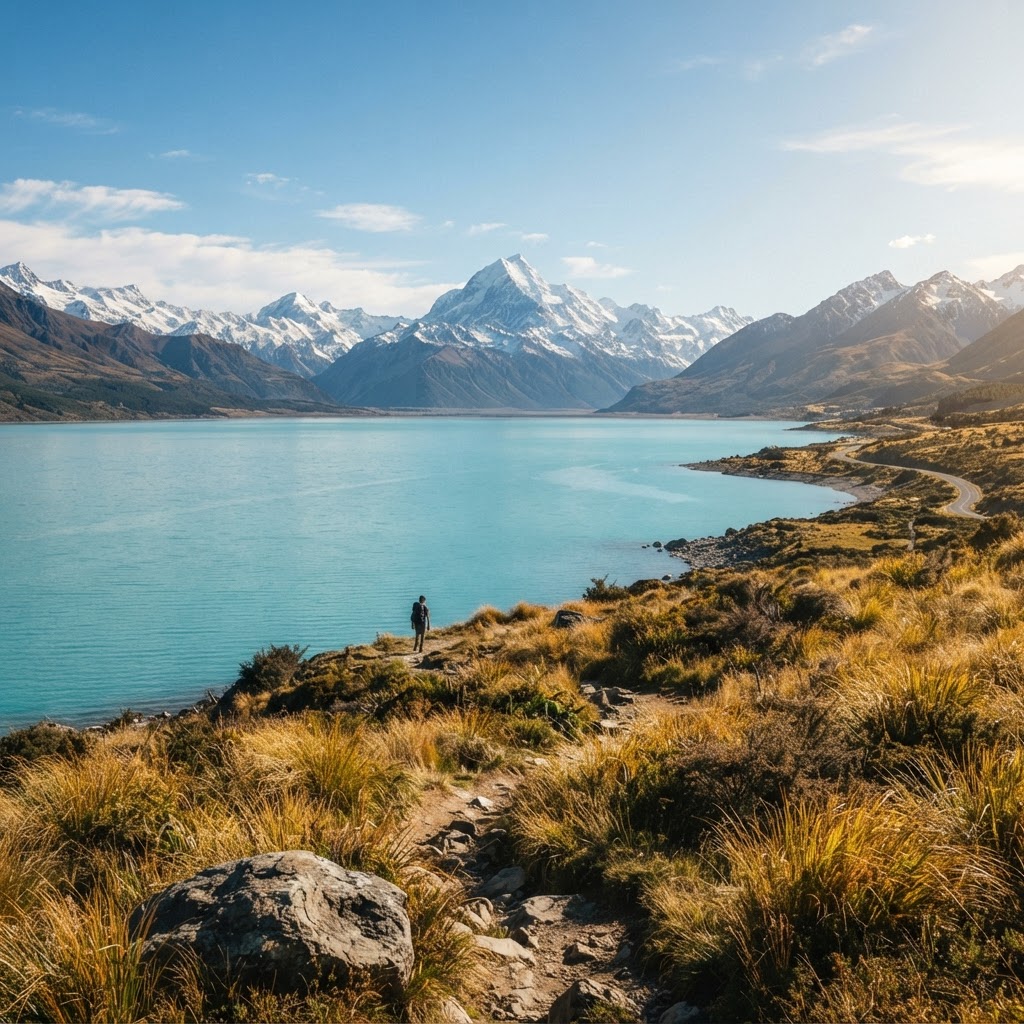
This is where the landscape opens up. The basin is 60 kilometres of tawny tussock grassland framed by the Two Thumb and Neumann Ranges to the west, the Benmore and Grampian Ranges to the east. On a clear day you'll see Aoraki/Mount Cook 70 kilometres to the northwest, the Liebig Range beyond Lake Tekapo, and nothing but sky.
Lake Pukaki appears around the two-hour mark, glacial turquoise against brown hills. The road follows the western shore for 30 kilometres. Most people stop at the Peter's Lookout to photograph Aoraki reflected in the lake. If you're hungry, the Mt Cook Alpine Salmon farm shop at the southern end serves sashimi and hot-smoked portions at picnic tables overlooking the water.
From Pukaki the road follows the Pukaki River southwest to Twizel, a service town built for the Waitaki hydro scheme in the 1970s. It has four fuel stations, a New World, and several adequate lunch spots. If you've timed it right, you'll stop here around midday.
Beyond Twizel the road climbs steadily through Lindis Pass, the lowest and most reliable of the South Island's alpine crossings. The summit sits at 971 metres, and the grade is gentle—nothing like the Crown Range or Haast Pass. The landscape here is schist rock and snow tussock, gold and grey, treeless and utterly empty. In winter you'll need snow chains in the vehicle, but the pass is prioritised for clearing and rarely closes for more than a few hours.
The descent into the Lindis Valley is 25 kilometres of sweeping corners through tussock basins, with the Pisa Range rising to the west. You join SH6 at Tarras, then it's 60 kilometres southwest via Cromwell and the Kawarau Gorge into Queenstown. Total driving time: five and a half to six hours, depending on stops.
When Ground Transfer Makes More Sense
Flying works brilliantly when it works. A smooth CHC-ZQN service gets you there in under an hour airborne. But the flight involves 90 minutes at Christchurch Airport (check-in, security, gate wait), 55 minutes flying, and 30 minutes from Queenstown Airport into town. That's three hours door-to-door when everything runs on time—and it frequently doesn't.
The ground route takes six hours, but it's predictable. You depart when you choose, not when the airline schedules. You're not at the mercy of a 30-knot crosswind at Frankton. Your luggage is in the vehicle with you, not checked to ZQN and possibly diverted to IVC. And if you're heading somewhere beyond Queenstown—Glenorchy, Cardrona, Wanaka—you're already in a vehicle pointed the right direction.
For groups of three or four, the economics shift dramatically. Four return flights at $220 each is $1,760. A private transfer splits one fixed cost across four passengers, includes luggage, golf clubs, ski gear, and doesn't charge extra for a Gibbston Valley winery stop or a detour to your Airbnb in Arrowtown.
If your destination is a lodge outside Queenstown—Blanket Bay, Matakauri, Aro Hā—the ground route often saves time. A Christchurch to Glenorchy transfer runs the same SH8 route, then continues 45 minutes up the lake. No coordination with rental car pick-ups, no white-knuckle drive on an unfamiliar gravel road after a delayed evening flight.
What the Drive Actually Looks Like
The SH8 route is not a tedious motorway slog. The first hour south from Christchurch along SH1 is flat farming country, yes—but once you turn west at Rangitata the landscape starts to lift. The road through Geraldine and up the Orari Gorge is winding two-lane blacktop through high-country sheep stations, with the foothills of the Southern Alps building to the west.
The Burkes Pass climb is short and scenic. The Mackenzie Basin beyond is genuinely dramatic—the kind of landscape that makes passengers put down their phones. Lake Pukaki is worth 15 minutes of your time. Lindis Pass in late afternoon light, when the tussock turns copper and the shadows stretch east, is as good as any view you'll get from a plane window.
You'll see virtually no traffic between Twizel and Tarras. The road is smooth, well-maintained, and empty. In winter it's cleared and gritted. In summer it's dry and fast. The only real delay risk is stock movement—occasionally a mob of sheep will occupy the road near Omarama, which costs you five minutes and provides excellent photos.
A professional driver who knows the route will read the conditions, adjust speed for weather, and build in time for a proper meal stop. You'll arrive in Queenstown having seen a cross-section of the South Island's interior that most tourists miss entirely.
The Third Option
Most people frame Christchurch to Queenstown as a binary choice: fly or rent a car. The flight is fast when it works, stressful when it doesn't. The rental car gives you flexibility but commits you to six hours of driving, navigation, fuel stops, and returning the vehicle.
There's a third option that combines the convenience of flying with the reliability of the road. A private transfer runs to your schedule, takes the same route a self-drive would, but puts a professional behind the wheel who's driven Lindis Pass in every season and knows where to stop for the best coffee between Twizel and Cromwell.
If your Queenstown flight has been delayed twice in the past year, or if you're travelling with family and the cost of four airfares makes you wince, it's worth getting a quote for the ground option. You'll leave on time, arrive on time, and see the Mackenzie Country in daylight instead of through a departure lounge window.
About the Author

James Whitfield
Senior Driver & South Island Route Specialist
James has driven every major South Island route for the past twelve years, specialising in alpine access and terrain logistics. He advises on winter transfers and lodge positioning across Canterbury and Otago.